
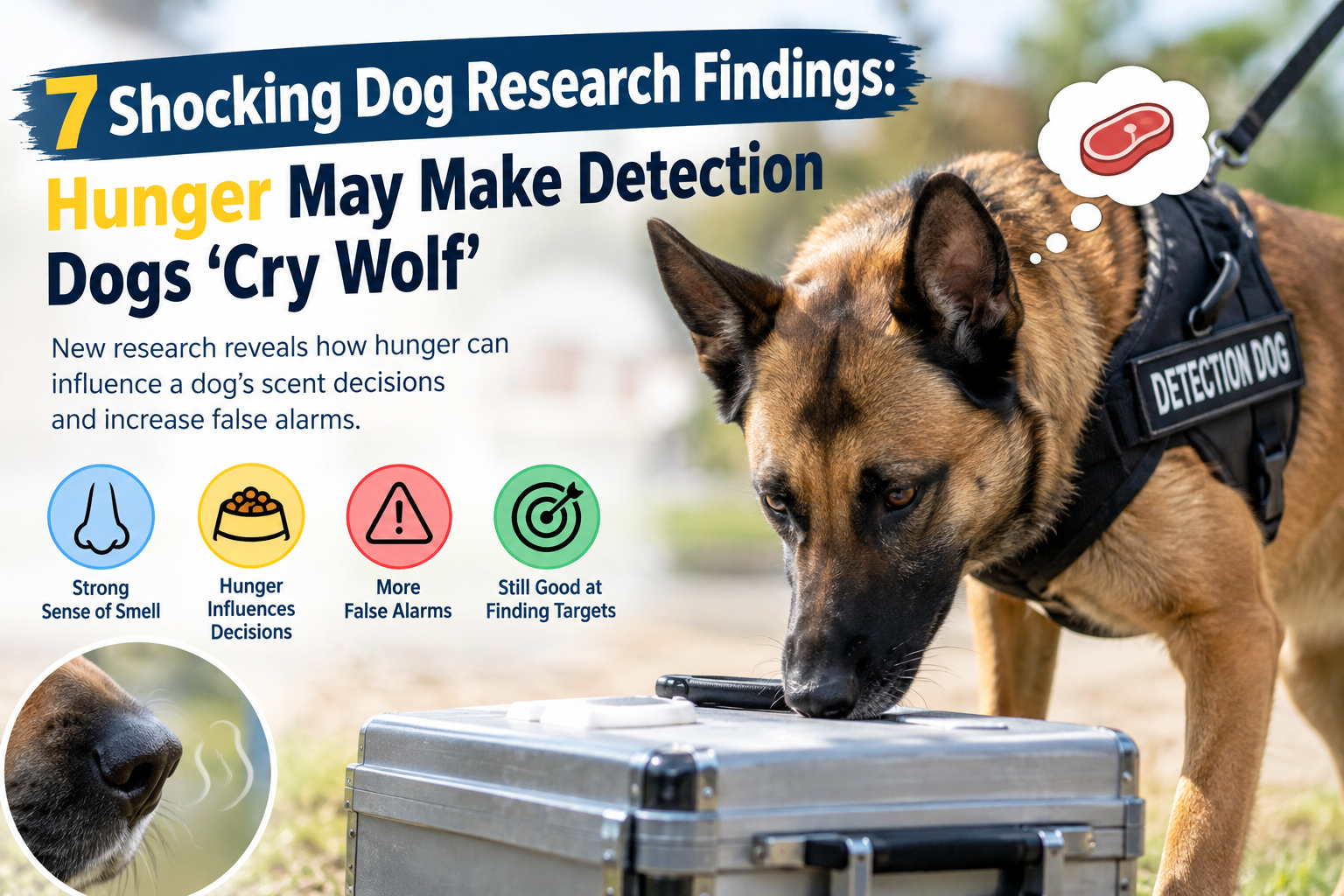
7 Shocking Dog Research Findings: Hunger May Make Detection Dogs ‘Cry Wolf’

Detection dogs are often trained to perform tasks that require extraordinary focus, patience, and consistency. Their powerful sense of smell has been used in conservation, disease detection, security, landmine searches, and many other specialist jobs. However, new research has shown that a dog’s feeding state may influence how scent decisions are made. The findings are especially interesting because the dogs did not simply become better or worse at smelling. Instead, their decisions about whether a scent was important appeared to be affected by hunger 7 Shocking Dog Research Findings.
Table of Contents
- What the New Study Discovered
- How the Dogs Were Tested
- Why Hunger Changed Their Decisions
- Understanding False Alarms
- Why the Findings Matter for Working Dogs
- What Trainers Should Understand
- Limits of the Research
- What Future Research Could Reveal
- FAQ
- Conclusion
What the New Study Discovered
The research behind 7 Shocking Dog Research Findings: Hunger May Make Detection Dogs ‘Cry Wolf’ was conducted by researchers from the University of Waikato and the University of Adelaide. Six trained scent-detection dogs were examined to determine whether their performance would change before and after a morning meal. 7 Shocking Dog Research Findings An automated scent-detection system was used, allowing responses to different odors to be measured in a controlled setting. The study was published in 2026 and has attracted attention because a simple assumption about hungry working dogs has been challenged.
7 Shocking Dog Research Findings According to the researchers, the dogs correctly identified the target odor at around 90% on average in both feeding conditions. Therefore, the ability to recognize the target itself was not dramatically reduced while the dogs were hungry. However, a more subtle difference was observed. When the dogs had not yet eaten, their ability to reject odors that were not the target was reduced. As a result, more false alarms were produced.
This distinction is important. 7 Shocking Dog Research Findings: Hunger May Make Detection Dogs ‘Cry Wolf’ points toward a change in decision-making rather than a simple loss of scent ability. In other words, the dogs appeared to remain capable of finding the correct smell, but they were more likely to respond positively when an incorrect smell was presented.
The finding is particularly interesting because detection work is based on both smelling and deciding. A dog may recognize many different odors, but it must still determine which one matches the trained target. Therefore, accurate scent detection cannot be judged only by how sensitive a dog’s nose is.
How the Dogs Were Tested
For the experiment described in 7 Shocking Dog Research Findings: Hunger May Make Detection Dogs ‘Cry Wolf’, six trained detection dogs were tested under different feeding conditions. A target was created from a mixture of four odors, and the dogs were assessed before and after their morning meal. An automated system was used to make the testing process more consistent and reduce variation that could have been introduced by human handlers.

7 Shocking Dog Research Findings The dogs were expected to indicate when the target odor was detected while withholding an indication when a non-target odor was presented. This distinction is essential in scent detection because a false indication can be costly. A working dog may be expected to locate a disease-related odor, identify a conservation target, or find a particular substance among many irrelevant smells.
Interestingly, the research did not show that hunger simply destroyed performance. Instead, 7 Shocking Dog Research Findings: Hunger May Make Detection Dogs ‘Cry Wolf’ is better understood through the difference between correct target detection and rejection of non-target odors. Target identification remained close to 90%, while the rejection of incorrect scents became weaker when the dogs were hungry.
That pattern suggests that motivation and decision criteria may interact. The dogs may have been more willing to respond when hungry, even when the evidence for a target was weaker. Consequently, the behavior could resemble a “cry wolf” effect, where an alert is given too often.
Why Hunger Changed the Dogs’ Decisions
Hunger can influence behavior in many animals, and dogs are no exception. When food is anticipated, attention and motivation can be altered. However, the new findings suggest that the effect may be more complicated than simply making a dog more focused.
The researchers’ interpretation is particularly useful because 7 Shocking Dog Research Findings: Hunger May Make Detection Dogs ‘Cry Wolf’ does not mean that hungry dogs suddenly lose their remarkable sense of smell. Instead, the dogs may have changed their response bias. A response bias is essentially the tendency to choose one type of response under uncertainty. In this case, the hungry dogs appeared more likely to give an indication rather than reject an uncertain odor.
7 Shocking Dog Research Findings This matters because scent detection is not only a sensory task. It is also a decision-making task. A dog must process odor information and then decide whether the evidence is strong enough to trigger a trained response. Therefore, even when the nose is functioning well, the final behavior can still be influenced by internal state.
Moreover, the effect was reduced after breakfast. Better rejection of non-target odors was observed after the dogs had been fed. This suggests that feeding status may have helped stabilize the dogs’ response criteria during the test.
Understanding False Alarms

The phrase “cry wolf” is used because a false alarm is created when a dog indicates a target that is not actually present. In practical scent work, repeated false indications can create serious problems.
For example, a detection dog searching for a specific substance may encounter dozens of irrelevant odors. If every interesting smell is treated as a target, the handler may be forced to investigate many locations unnecessarily. Therefore, reliable rejection of non-target scents is just as important as successful target detection.
This is one reason 7 Shocking Dog Research Findings: Hunger May Make Detection Dogs ‘Cry Wolf’ is receiving attention among people interested in canine performance. A dog that remains accurate at finding a target but becomes more likely to alert incorrectly may appear highly motivated while actually becoming less precise.
The study therefore highlights a useful lesson: performance should not always be judged by the number of alerts produced. Instead, correct indications and correct refusals should both be measured. A dog that alerts frequently is not necessarily performing better.
Why the Findings Matter for Working Dogs
Working dogs are used in situations where accuracy can be more valuable than speed. Conservation dogs may be trained to locate animal scents, while medical detection dogs can be trained to identify biological odor patterns. Security and search dogs may also be required to distinguish a target from a large background of irrelevant smells.
In these settings, 7 Shocking Dog Research Findings: Hunger May Make Detection Dogs ‘Cry Wolf’ could encourage trainers and researchers to pay closer attention to feeding schedules. If hunger increases false alarms in some dogs, the timing of meals might become one factor worth considering when performance is being evaluated.
7 Shocking Dog Research Findings However, the research should not be interpreted as a recommendation that every detection dog must be fed immediately before work. Different jobs require different levels of physical and mental effort, and individual dogs can respond differently. Training methods, reinforcement schedules, work duration, and the type of detection task can also influence behavior.
Instead, the findings provide a reason to examine the complete working routine. A dog’s internal state, environment, training history, and task demands may all interact. Therefore, feeding should be considered as one part of a broader performance strategy rather than as a universal solution.
What Trainers Should Understand
One of the most useful lessons from 7 Shocking Dog Research Findings: Hunger May Make Detection Dogs ‘Cry Wolf’ is that motivation should not automatically be equated with accuracy. Food motivation can be valuable during training because rewards are often used to strengthen desired behavior. Nevertheless, a highly food-motivated dog may not always make the same decisions when it is hungry.
For trainers, careful performance records can therefore be useful. Correct alerts, false alarms, missed targets, and refusals could be recorded under different conditions. Over time, patterns may become visible. If a particular dog produces more false indications when hungry, that observation could be considered during future training or testing.
Additionally, handlers should avoid making large changes based on one experiment. Feeding routines should be adjusted carefully and with the dog’s welfare in mind. A suitable plan may depend on the animal, the assignment, and the reward system being used.
The broader message from 7 Shocking Dog Research Findings: Hunger May Make Detection Dogs ‘Cry Wolf’ is that canine performance is shaped by more than scent sensitivity alone. Attention, motivation, learning, and decision-making are all involved.
Limits of the Research
The study is important, but 7 Shocking Dog Research Findings: Hunger May Make Detection Dogs ‘Cry Wolf’ should also be viewed within the limits of the evidence. Only six dogs were tested, which is a very small sample. Although the results were consistent enough to reveal a meaningful pattern, they cannot automatically be applied to every breed, age group, training background, or working environment.
Furthermore, the experiment was conducted under controlled conditions. Real-world detection tasks can be much more complicated. Weather, distractions, handler behavior, fatigue, unfamiliar locations, and competing odors may all influence performance.
The type of scent task also matters. A dog trained for conservation work may behave differently from a dog trained for security or medical detection. Consequently, broader studies will be needed before general feeding recommendations can be developed.
What Future Research Could Reveal
7 Shocking Dog Research Findings Future research could examine whether the same effect is observed in larger groups of dogs and across different detection disciplines. It could also be investigated whether the strength of the effect changes according to the length of fasting, the type of food provided, or the difficulty of the scent task.
Researchers may also explore whether individual personality and training history affect response bias. Some dogs could be naturally more cautious, while others might be more willing to indicate when uncertain.
In addition, 7 Shocking Dog Research Findings: Hunger May Make Detection Dogs ‘Cry Wolf’ raises questions about how internal states influence animal decision-making more broadly. Similar research could potentially help explain how hunger, fatigue, excitement, or stress affect performance in animals that are trained for complex tasks.
The findings could also encourage more detailed testing of working dogs before they are assigned to demanding jobs. Rather than relying on one performance score, several measures could be considered. Such an approach would provide a clearer picture of reliability.
FAQ
Does hunger make detection dogs smell better?
Not necessarily. The study found that target identification remained around 90% in both conditions. The main difference was that hungry dogs were less successful at rejecting non-target odors.
Why were false alarms increased?
The findings suggest that hunger may have changed the dogs’ response bias. They appeared more willing to indicate an odor even when it was not the target.
Should detection dogs always be fed before work?
No universal feeding rule can be recommended from this small study. Individual dogs, task requirements, training methods, and welfare considerations should all be taken into account.
Does this mean hungry dogs are poor detection dogs?
No. 7 Shocking Dog Research Findings: Hunger May Make Detection Dogs ‘Cry Wolf’ does not show that hungry dogs lose their scent-detection ability. Instead, it suggests that hunger may influence how they make decisions after processing an odor.
What types of jobs could be affected?
Potentially, any scent-based work could be relevant, including conservation, disease detection, security, search tasks, and scent-work sports. More research is needed to determine how widely the effect applies.
Conclusion
7 Shocking Dog Research Findings The new findings provide a fascinating look at the hidden factors that can shape canine scent work. 7 Shocking Dog Research Findings: Hunger May Make Detection Dogs ‘Cry Wolf’ shows that hunger may influence not the basic ability to recognize a target, but the decision about whether an odor deserves an alert. Because false alarms can reduce reliability, that distinction is highly important for professional detection work.
At the same time, the study should be treated as an early piece of evidence rather than a final rule for trainers. Only six dogs were examined, and real-world work is far more complicated than a controlled experiment. Nevertheless, the results show why working-dog performance should be measured from several angles.
Ultimately, 7 Shocking Dog Research Findings: Hunger May Make Detection Dogs ‘Cry Wolf’ reminds us that a dog’s extraordinary nose is only one part of the detection process. Sensory information must be combined with attention, motivation, learning, and decision-making. As further research is conducted, a better understanding of these factors could help detection dogs be trained and managed more effectively.