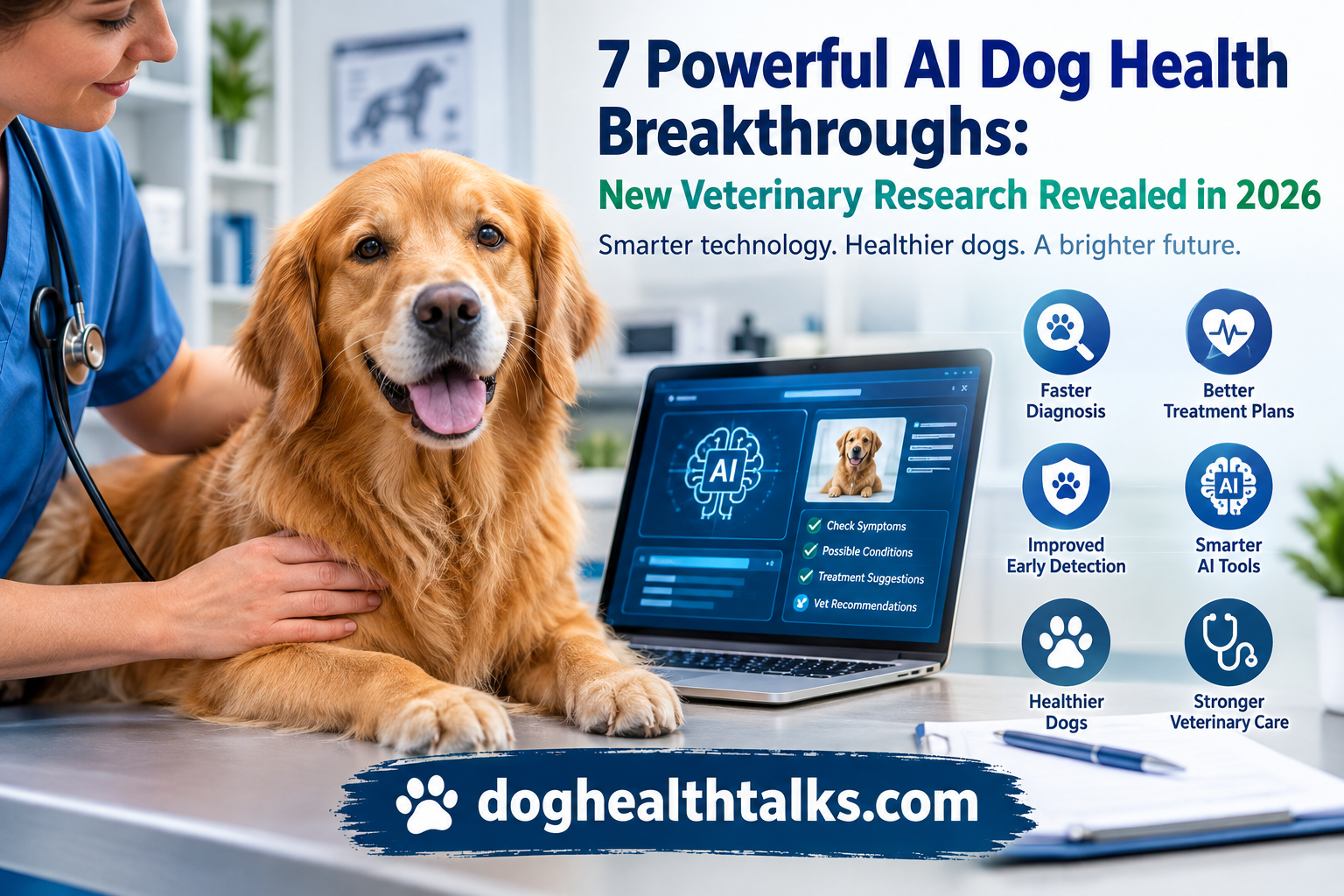
7 Powerful AI Dog Health Breakthroughs: New Veterinary Research Revealed in 2026
Artificial intelligence is being used in veterinary medicine in increasingly practical ways, and new 2026 research has brought fresh attention to how well AI can handle real dog-health questions. A new research project called PetQA has been developed to evaluate veterinary knowledge and clinical reasoning in large language models and vision-language models. Real-world questions about dogs and cats were collected and were paired with answers from expert veterinarians. The resource contains 10,076 text-only question-answer pairs and 8,751 multimodal pairs involving images and text.
AI Dog Health Breakthroughs The findings are important because pet owners are increasingly turning to digital tools when unusual symptoms are noticed. However, veterinary advice cannot be treated like a simple search result. A dog’s age, breed, medical history, symptoms, medication, and physical examination can all change the correct interpretation. Therefore, AI systems are now being tested not only for fluent answers but also for factuality, clinical reasoning, and usefulness.
7 Powerful AI Dog Health Breakthroughs: New Veterinary Research Revealed in 2026 is especially relevant because the research shows both the promise and the limitations of AI in animal care. The work is not a new diagnostic device, and it is not being presented as a replacement for veterinarians. Instead, a structured way of measuring whether AI systems can respond responsibly to realistic veterinary questions has been created.
Table of Contents
- What Is the New Veterinary AI Research?
- Why Dog Health Questions Are Difficult
- Seven Major AI Dog Health Breakthroughs
- How PetQA Was Built
- What the AI Models Were Tested On
- Why Images Make Dog Health Questions Harder
- What This Means for Pet Owners
- Limitations and Safety Concerns
- The Future of AI in Veterinary Care
- FAQs
- Conclusion
What Is the New Veterinary AI Research?
The research is centered on PetQA, a Korean long-form question-answering benchmark designed to evaluate veterinary knowledge and clinical reasoning in large language models and large vision-language models. Real-world veterinary questions were collected from a major online question-and-answer platform in South Korea, while expert answers were also included as references.
AI Dog Health Breakthroughs The dataset was designed around dogs and cats because they are among the most common companion animals in veterinary practice. After filtering and processing, 10,076 text-only and 8,751 multimodal question-answer pairs were included. The test benchmark, called PetQA-Bench, contains 2,000 test questions for each modality, allowing AI models to be compared under controlled conditions.
7 Powerful AI Dog Health Breakthroughs: New Veterinary Research Revealed in 2026 highlights a major shift in veterinary AI research because realistic questions are being used instead of relying only on textbook-style examinations. This matters because pet owners usually describe symptoms in ordinary language, and photographs may be supplied when something unusual is visible.
Why Dog Health Questions Are Difficult

Dog health cannot be reduced to a simple list of symptoms. For example, coughing can be caused by several different conditions, while vomiting can range from a minor digestive problem to a serious medical issue. Similarly, a skin lesion may need to be interpreted differently depending on its location, appearance, duration, and the dog’s overall health.
Because of this complexity, an AI system must be able to connect several pieces of information. A useful response may need to include possible causes, warning signs, questions that should be asked next, and reasons why veterinary examination is recommended. Moreover, an answer that sounds confident but is medically wrong could create a serious risk.
The PetQA project was therefore created to measure veterinary knowledge and clinical reasoning in realistic situations. Eighteen AI models were evaluated using several metrics, including ROUGE, BERTScore, factuality, and helpfulness. Both text-only and multimodal questions were included.
Seven Major AI Dog Health Breakthroughs
Real-World Veterinary Questions Are Being Used
One of the strongest developments is that realistic pet-health questions are being placed at the center of evaluation. Instead of testing only basic facts, the benchmark includes questions related to diagnosis, treatment, basic veterinary knowledge, and miscellaneous veterinary issues.
AI Dog Health Breakthroughs This approach makes the evaluation more practical. A pet owner may ask whether a dog’s repeated vomiting is dangerous, what a skin change could indicate, or what should be done after an injury. Such questions require context rather than a single memorized fact.
7 Powerful AI Dog Health Breakthroughs: New Veterinary Research Revealed in 2026 shows why realistic questions can provide a more useful test of AI than simple multiple-choice examinations.
Expert Veterinary Answers Are Being Used as References
Another important step is the use of expert-provided answers. The benchmark was built with answers from verified veterinary experts, which means AI responses can be compared with professional reference material.
AI Dog Health Breakthroughs This creates a stronger evaluation framework. If an AI response is incomplete, misleading, or factually incorrect, those weaknesses can be identified more clearly. At the same time, helpful responses can be separated from answers that only appear convincing because they are written fluently.
The goal is not to make AI sound like a veterinarian. Instead, the goal is to determine whether AI can provide information that is accurate enough to support safer veterinary communication.
Multimodal Dog Health Questions Are Being Tested

Images are extremely important in veterinary medicine. A photograph may show a skin lesion, dental problem, wound, swelling, eye issue, or another visible sign. Consequently, the ability to understand both an image and a written description could become valuable.
PetQA includes 8,751 multimodal question-answer pairs, making visual reasoning an important part of the benchmark. However, the study also found that models performed worse on multimodal questions than on text-only questions. This limitation is significant because a photograph may contain subtle clinical details that are difficult for an AI model to interpret reliably.
7 Powerful AI Dog Health Breakthroughs: New Veterinary Research Revealed in 2026 therefore includes an important warning: adding images does not automatically make AI veterinary advice safer or more accurate.
Clinical Reasoning Is Being Measured
AI performance is increasingly being evaluated beyond simple factual recall. PetQA includes diagnosis-related questions, treatment-related questions, basic veterinary knowledge, and miscellaneous categories.
Diagnosis questions can be particularly demanding because several conditions may share similar signs. Treatment questions can also be difficult because medication choices, doses, contraindications, and follow-up needs can depend on information that is not available in a short online description.
By testing these categories separately, researchers can identify where AI performs well and where additional improvement is needed. This type of evaluation could eventually help researchers build systems that are more cautious when uncertainty is present.
Multiple AI Evaluation Methods Are Being Combined
The study does not depend on a single score. ROUGE and BERTScore are used as traditional comparison measures, while factuality and helpfulness are also assessed. This combination is useful because a response can resemble a reference answer while still missing an important warning.
The helpfulness assessment was performed with an LLM-based judge, while factuality was evaluated against expert-provided answers. Therefore, several dimensions of response quality could be examined at the same time.
7 Powerful AI Dog Health Breakthroughs: New Veterinary Research Revealed in 2026 demonstrates how veterinary AI is being evaluated more carefully rather than being judged only by whether an answer sounds natural.
AI Performance Can Improve, But Not Consistently
The researchers also examined retrieval-augmented generation, known as RAG, and supervised fine-tuning, known as SFT. With RAG, an AI model can be supplied with external veterinary reference information. With SFT, the model can be trained using relevant examples.
AI Dog Health Breakthroughs These approaches can be useful, but the research found that improvements were not consistent across all LLM-as-a-judge metrics. This suggests that simply adding more information or training does not guarantee clinically reliable answers.
In practical terms, an AI system may become better at one type of question while remaining weak in another. Therefore, continuous testing will still be required before these systems can be trusted in sensitive veterinary settings.
Veterinary AI Could Become a Useful Support Tool
AI Dog Health Breakthroughs The most encouraging development is not that AI is ready to replace veterinarians. Rather, AI could eventually be used as a support tool for information organization, symptom triage, educational explanations, record summarization, and communication.
A veterinary professional could potentially use AI to organize a long medical history before a consultation, while pet owners could use carefully designed tools to understand basic veterinary terminology. However, final clinical decisions should remain with qualified professionals, especially when a dog is seriously ill.
7 Powerful AI Dog Health Breakthroughs: New Veterinary Research Revealed in 2026 should therefore be viewed as a story about better evaluation and safer development, not as proof that AI can diagnose dogs independently.
How PetQA Was Built
The research team collected veterinary question-and-answer material from Naver Knowledge iN, a major community-driven online platform in South Korea. The original collection contained 83,509 posts published between 2014 and 2024, each with at least one answer selected as helpful by the questioner.
After filtering, 27,124 posts about dogs and cats with answers from verified experts were retained for further processing. Additional filtering was performed to remove duplicates, corrupted images, irrelevant content, unsupported speculation, and uninformative answers.
AI Dog Health Breakthroughs The final resource was divided into text-only and multimodal sections. The text dataset contained 6,076 training questions, 2,000 validation questions, and 2,000 test questions. The multimodal dataset contained 4,751 training questions, 2,000 validation questions, and 2,000 test questions.
AI Dog Health Breakthroughs The benchmark also classified questions into diagnosis, treatment, basic veterinary knowledge, and miscellaneous categories. This structure allows researchers to examine whether models struggle more with certain types of veterinary reasoning.
7 Powerful AI Dog Health Breakthroughs: New Veterinary Research Revealed in 2026 is significant here because a large amount of real-world material was transformed into a structured benchmark that can be repeatedly used for AI evaluation.
What the AI Models Were Tested On
Eighteen AI models were evaluated during the research. The models were grouped into closed vision-language models, open-weight vision-language models, and open-weight language models.
The study found that closed models generally performed better than open-weight models, particularly for factuality and helpfulness. However, no model should be interpreted as being universally reliable for veterinary diagnosis.
AI Dog Health Breakthroughs The benchmark also showed that multimodal questions were more difficult than text-only questions across the evaluated models. This finding is especially important because visual symptoms are common in animal health.
7 Powerful AI Dog Health Breakthroughs: New Veterinary Research Revealed in 2026 shows that veterinary AI must be tested in the same complicated environments where it may eventually be used.
Dataset Graph
The PetQA resource contains two major question formats. Their sizes are shown below:
PetQA Question-Answer Pairs

Text-only      10,076 | ████████████████████████████████████████
Multimodal      8,751 | ███████████████████████████████████

Total          18,827 question-answer pairs
The graph shows that both categories are substantial. Text-only questions form the larger group, while multimodal questions also represent a major portion of the benchmark. This balance is useful because veterinary AI needs to handle both written descriptions and image-supported cases.
Why Images Make Dog Health Questions Harder
AI Dog Health Breakthroughs A photograph can be useful, but it can also be misleading. Lighting, camera angle, image quality, fur, skin pigmentation, and the location of a lesion can all affect what is visible. Furthermore, important information may not be visible in a photograph at all.
For example, a dog may appear to have a mild skin problem while also experiencing fever, pain, appetite loss, or lethargy. Those signs would need to be considered together. Therefore, an image-based AI system should not be treated as a substitute for physical examination.
AI Dog Health Breakthroughs The study’s finding that multimodal questions were harder than text-only questions reinforces this point. AI vision can be helpful, but it should be treated as an additional source of information rather than a definitive clinical examination.
7 Powerful AI Dog Health Breakthroughs: New Veterinary Research Revealed in 2026 makes this distinction especially important for pet owners who may be tempted to upload a photograph and rely entirely on an automated answer.
What This Means for Pet Owners
For dog owners, the research offers both excitement and caution. Digital tools are becoming more capable, and useful veterinary information may become easier to organize and understand. However, responsible use will remain essential.
AI Dog Health Breakthroughs An AI tool may help a pet owner prepare questions for a veterinarian, organize a dog’s symptoms by date, understand basic medical terms, or recognize that a situation may require professional attention. Nevertheless, serious symptoms should not be managed through AI alone.
If a dog is having difficulty breathing, experiencing seizures, suffering severe bleeding, collapsing, showing signs of poisoning, or rapidly deteriorating, emergency veterinary care should be sought immediately. AI should never be used to delay urgent treatment.
7 Powerful AI Dog Health Breakthroughs: New Veterinary Research Revealed in 2026 is therefore best understood as evidence that better veterinary AI tools are being researched, not evidence that pet owners can safely replace professional care.
Limitations and Safety Concerns
AI Dog Health Breakthroughs The PetQA study is an important benchmark, but it is still a research resource. It does not prove that AI systems can diagnose animals accurately in everyday veterinary clinics.
The dataset is based on questions from a South Korean platform, and the source language and cultural context may influence the types of questions represented. Although translated versions were created in several languages, translation does not automatically guarantee identical clinical meaning.
Another limitation is that real veterinary decisions are based on examination, laboratory testing, imaging, medical history, and professional judgment. A text or photograph cannot always capture these factors.
There is also a risk of automation bias. People may trust an AI response simply because it is presented confidently. That risk becomes more serious when the answer concerns medication or a potentially life-threatening condition.
7 Powerful AI Dog Health Breakthroughs: New Veterinary Research Revealed in 2026 should therefore be read as research into safer AI development rather than as a claim that current systems are ready for independent veterinary diagnosis.
The Future of AI in Veterinary Care
The future of veterinary AI is likely to be built around cooperation rather than replacement. Better systems could be connected to veterinary records, imaging, laboratory results, wearable devices, and validated clinical references. When these sources are combined carefully, more useful decision-support systems may be developed.
However, external validation will be needed. Models should be tested across different breeds, ages, diseases, clinics, languages, and image conditions. Performance should also be monitored after deployment because real-world cases can differ from benchmark questions.
Future systems may also be designed to communicate uncertainty more clearly. Instead of providing a single confident answer, an AI tool could explain several possibilities, identify missing information, and recommend professional evaluation when risk is detected.
7 Powerful AI Dog Health Breakthroughs: New Veterinary Research Revealed in 2026 points toward a future in which AI may become more useful when it is trained, tested, and supervised appropriately.
FAQs
Can AI diagnose my dog?
AI can provide general information and help organize symptoms, but it should not be treated as a definitive diagnostic tool. A veterinarian should be consulted for diagnosis and treatment decisions.
What is PetQA?
PetQA is a veterinary question-answering benchmark containing 10,076 text-only and 8,751 multimodal question-answer pairs about dogs and cats, with expert veterinary answers used as references.
Why are multimodal veterinary questions difficult?
Images can contain subtle details that are affected by lighting, camera angle, image quality, and missing clinical context. Therefore, visual questions can be harder for AI systems to answer reliably.
Can AI replace a veterinarian?
No. AI may become a useful support tool, but physical examination, diagnostic testing, professional judgment, and emergency care cannot be replaced by a chatbot.
Is the new research only about dogs?
No. PetQA covers both dogs and cats, although the benchmark contains a substantial number of dog-related questions.
Should dog owners use AI for serious symptoms?
AI should not be relied upon for emergencies or serious symptoms. When a dog is experiencing severe breathing problems, collapse, seizures, poisoning, major bleeding, or rapid deterioration, professional veterinary care should be sought immediately.
Conclusion
The development of PetQA represents a meaningful step in the evaluation of AI for animal health. By using real-world veterinary questions, expert answers, text, and images, the benchmark provides a more realistic way to examine what current AI systems can and cannot do.
7 Powerful AI Dog Health Breakthroughs: New Veterinary Research Revealed in 2026 is ultimately a story about responsible innovation. The technology is becoming more capable, but important weaknesses are still being exposed. Multimodal reasoning remains challenging, improvements from additional training are not always consistent, and professional veterinary oversight remains essential.
For pet owners, the message is simple: AI can become a helpful source of information, but it should not be treated as a replacement for a veterinarian. As stronger benchmarks and better clinical validation are developed, safer and more useful veterinary AI tools may gradually become available.