
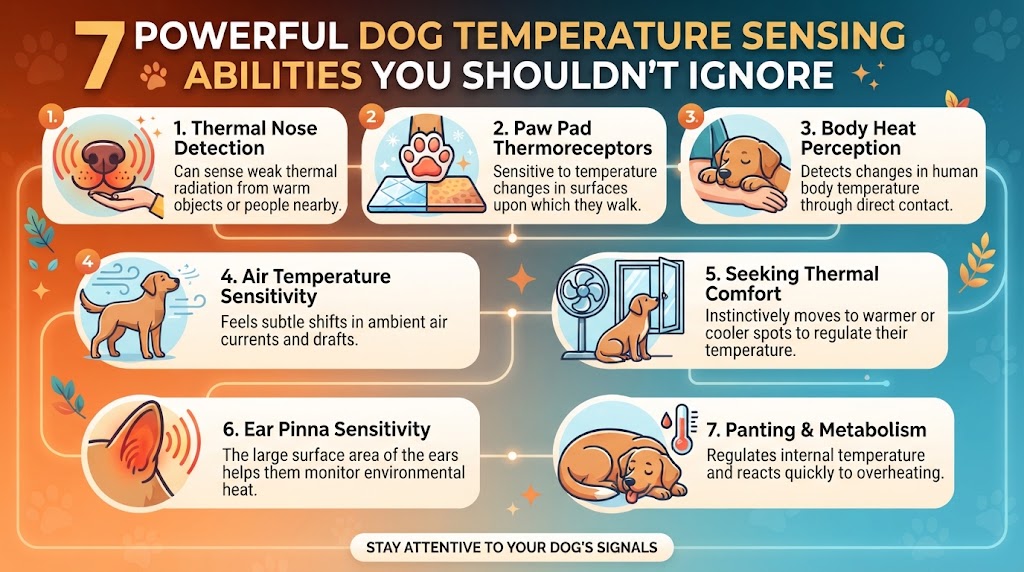
7 Powerful Dog Temperature Sensing Abilities You Shouldn’t Ignore
Understanding Dog Temperature Sensing Abilities can give pet owners a fascinating look into how dogs experience the world around them. Dogs do not experience hot and cold exactly like humans do. Their bodies use several biological systems to detect temperature, control internal heat, and respond to changing environments. From thermal sensation in the skin and paws to panting and blood-flow changes, these abilities help dogs maintain a stable internal temperature. Researchers continue to study these mechanisms because understanding canine thermoregulation can improve animal care, veterinary monitoring, and heat-safety practices.
Table of Contents
- What Are Dog Temperature Sensing Abilities?
- Dog Temperature Sensing Abilities in the Skin
- Dog Temperature Sensing Abilities in the Paws
- Dog Temperature Sensing Abilities and Panting
- Dog Temperature Sensing Abilities During Cold Weather
- Dog Temperature Sensing Abilities and Blood Flow
- Dog Temperature Sensing Abilities Studied With Thermal Cameras
- Why Dog Temperature Sensing Abilities Matter
- Final Thoughts
What Are Dog Temperature Sensing Abilities?
Dog Temperature Sensing Abilities refer to the ways a dog’s nervous system and body detect thermal changes and respond to them. Temperature sensation is not simply about knowing whether something feels hot or cold. It involves sensory receptors, nerves, blood vessels, skin, paws, and the brain working together.
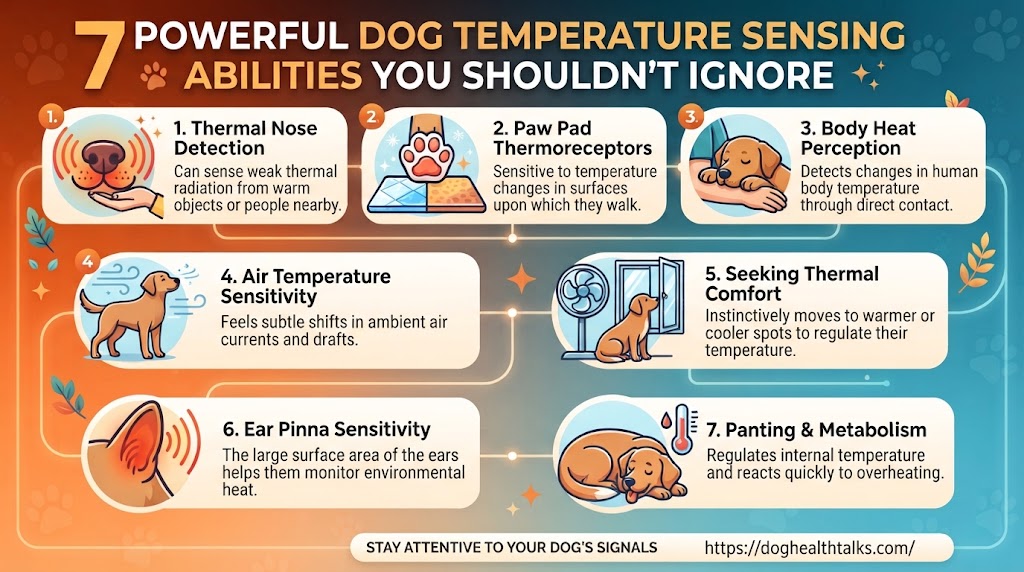
Dogs also have powerful mechanisms for keeping their internal temperature within a relatively narrow range. Their normal body temperature is generally higher than that of humans, with the American Kennel Club giving an average around 101.5°F, while noting that normal values vary among individual dogs.
This means that a dog can be exposed to a changing environment while its internal systems continuously work to maintain thermal balance.
How Dog Temperature Sensing Abilities Work
When temperature changes around the body, thermal and sensory receptors can detect those changes. Signals are then processed through the nervous system, allowing the animal to respond.
For example, a dog exposed to excessive heat may begin panting, change its activity level, seek shade, or drink water. In cold conditions, its coat, blood circulation, behavior, and metabolism can all contribute to maintaining body heat.
Dog Temperature Sensing Abilities in the Skin
One of the most important areas researchers study is how dogs detect thermal changes through their skin and nervous system.
The skin contains sensory structures that respond to different forms of stimulation, including temperature. Veterinary researchers have also used quantitative sensory testing to measure thermal thresholds in dogs. In one study, researchers tested hot and cold stimuli in dogs and found that thermal sensory responses could be measured experimentally.
Why Thermal Sensation Matters
Dog Temperature Sensing Abilities allow dogs to respond to environmental changes before those changes necessarily become dangerous. A dog may move away from a cold surface, avoid a hot area, or change its behavior when environmental conditions become uncomfortable.
However, temperature sensing should not be confused with perfect temperature awareness. A dog can still remain in a dangerous environment, particularly when excited, exercising, confined, or exposed to intense heat.
That is why owners should not rely only on a dog’s behavior to determine whether conditions are safe.
Dog Temperature Sensing Abilities in the Paws
The paws are particularly interesting when studying Dog Temperature Sensing Abilities. Dog paw pads contain sweat glands, although sweating through the paws plays only a limited role in overall cooling. Dogs primarily rely on panting for heat loss.
The structure of canine paws also helps researchers understand temperature regulation. Research has examined how the relatively hairless skin of the paws participates in thermal processes. A recent pilot study investigated warming the front paws of anesthetized dogs and examined changes in body temperature.
Dog Temperature Sensing Abilities and Paw Protection
Paws can also be exposed directly to environmental temperatures. Hot pavement, ice, snow, and very cold surfaces can create localized thermal stress.
Recent 2026 research into dogs walking in hot and sunny conditions measured temperatures from the coat, skin, paw pads, and rectum. The study found substantial increases in coat and skin temperatures under stronger heat loads, demonstrating why environmental conditions matter even when a dog’s core temperature remains comparatively controlled.
Dog Temperature Sensing Abilities and Panting
One of the most visible responses connected with Dog Temperature Sensing Abilities is panting.
Unlike humans, dogs do not depend primarily on widespread sweating to cool themselves. Panting helps evaporate moisture from the respiratory surfaces and is a major part of canine heat regulation. Dogs can also use changes in blood-vessel diameter to help release heat.
Why Dogs Pant When They Are Hot
When a dog’s body needs to lose heat, breathing becomes faster and more pronounced. Moisture associated with the tongue, mouth, nasal passages, and respiratory system can evaporate, helping remove heat.
This process is useful, but it has limits. In very hot or humid environments, heat loss becomes more difficult.
That is why excessive panting should never automatically be dismissed as normal behavior.
Dog Temperature Sensing Abilities During Cold Weather
Dog Temperature Sensing Abilities are also important when temperatures fall.
Dogs have several natural features that help them handle cold conditions. Fur provides insulation, while blood circulation helps distribute heat around the body.
Some breeds have particularly dense coats and adaptations associated with cold environments. Certain northern breeds also have specialized paw structures that help limit heat loss.
How Dog Temperature Sensing Abilities Help in Cold
A dog may respond to cold by changing its posture, seeking warmer areas, reducing exposure, or becoming less active.
But breed, body size, coat type, age, health, and environmental conditions all influence cold tolerance. A thick coat does not make a dog immune to hypothermia or frostbite.
Owners should therefore treat environmental temperature as an important factor rather than assuming every dog can tolerate the same conditions.
Dog Temperature Sensing Abilities and Blood Flow
Another fascinating part of Dog Temperature Sensing Abilities involves circulation.
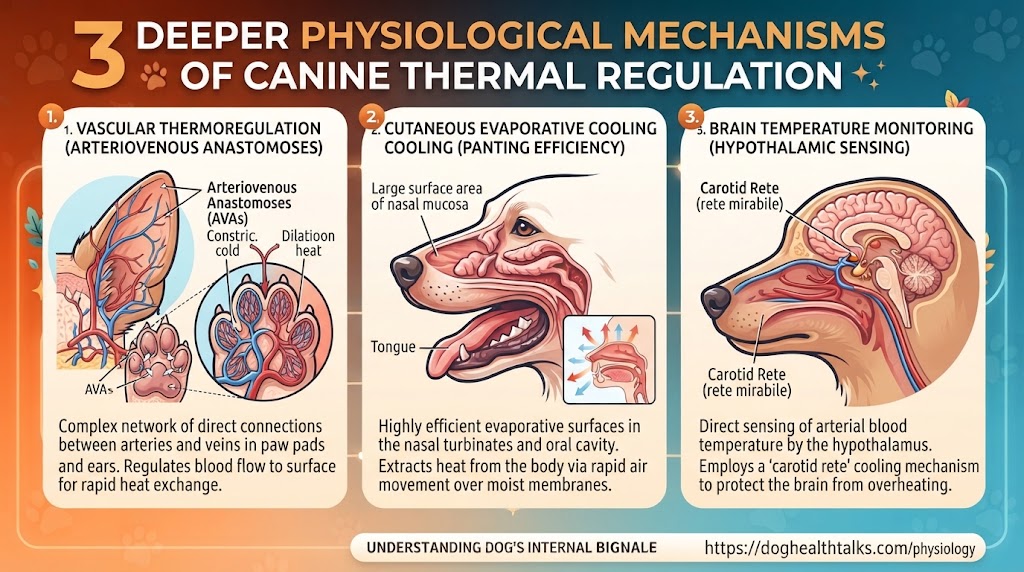
Blood vessels can expand or contract in response to temperature-related demands. When the body needs to release heat, increased blood flow toward certain body surfaces can assist heat transfer.
The ears and face can be particularly important in heat exchange. Dogs also possess specialized vascular structures in their paws that researchers have studied in relation to heat conservation.
The Interesting Role of Dog Paws
In some cold-adapted dogs, the arrangement of arteries and veins within the paws can support heat exchange. Warm arterial blood can transfer heat to cooler returning blood, helping reduce overall heat loss from the extremities.
This is one reason canine thermal biology is more complicated than simply saying that dogs “feel hot” or “feel cold.”
Dog Temperature Sensing Abilities Studied With Thermal Cameras
Modern technology has created another way to study Dog Temperature Sensing Abilities.
Infrared thermography allows researchers to examine surface temperature without physically touching an animal. Researchers are investigating whether thermal imaging can help monitor physiological changes in dogs.
A recent study examined ocular temperature in dogs using infrared thermography. It found an association between eye temperature and rectal temperature, while also showing that environmental factors such as humidity can influence measurements. Importantly, eye temperature was not interchangeable with rectal temperature.
Why Thermal Imaging Is Interesting
Thermal cameras could potentially provide researchers and veterinarians with additional information about temperature patterns without requiring the same type of direct measurement every time.
However, thermal images should not be interpreted as a simple replacement for established veterinary temperature measurements. The research is still examining how environmental and biological variables influence readings.
Ways researchers study canine temperature responses
A conceptual comparison of research approaches discussed in canine thermal studies; values represent relative research focus, not measured prevalence.0255075100
Thermal sensory testing
Paw temperature
Core temperature
Respiratory response
Infrared thermography
The chart is a conceptual visualization for reader understanding, not a scientific prevalence ranking.
Why Dog Temperature Sensing Abilities Matter
Learning about Dog Temperature Sensing Abilities is useful because temperature affects almost every aspect of canine wellbeing.
Heat exposure can become dangerous when a dog’s cooling mechanisms cannot keep up with environmental heat. The risk can increase during exercise, high humidity, confinement, or extremely hot weather. Veterinary sources emphasize that heatstroke can become life-threatening and requires prompt attention.
Cold exposure also deserves attention, especially for dogs with particular coat types, small body sizes, or limited tolerance for low temperatures.
The most important lesson is that temperature regulation is a whole-body process. Paws, skin, blood vessels, respiratory mechanisms, coat insulation, sensory pathways, and behavior can all contribute.
Final Thoughts on Dog Temperature Sensing Abilities
Dog Temperature Sensing Abilities reveal just how sophisticated canine thermoregulation can be. Dogs detect thermal changes through sensory systems, respond through behavioral changes, and regulate body heat using mechanisms such as panting, circulation, insulation, and limited paw sweating.
Researchers are also exploring newer methods such as infrared thermography to understand canine temperature patterns in greater detail. Recent studies show that temperature responses can vary depending on environmental conditions and the part of the body being measured.
For dog owners, the practical takeaway is simple: never assume that a dog will always move away from dangerous temperatures on its own. Understanding Dog Temperature Sensing Abilities can help owners recognize why heat, cold, pavement, exercise, and environmental conditions deserve careful attention.
