
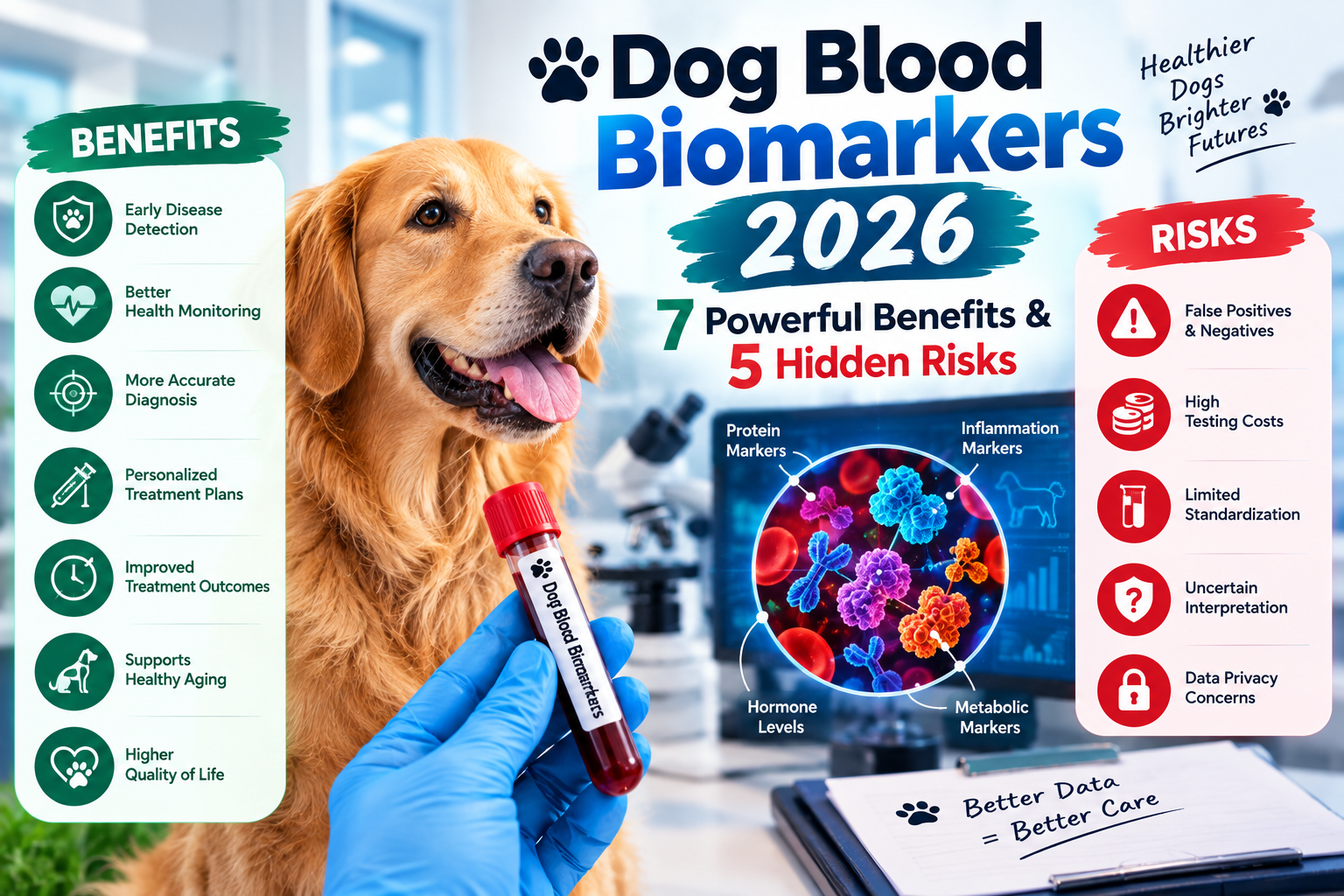
Dog Blood Biomarkers 2026: 7 Powerful Benefits & 5 Hidden Risks
Dog Blood Biomarkers 2026 are becoming an important part of modern veterinary health monitoring. Blood contains many measurable signals that can give veterinarians information about inflammation, organ function, immune activity, metabolism, aging, and disease. Recent veterinary research is also exploring newer biomarkers that may improve diagnosis and health monitoring in dogs.

Table of Contents
- What Are Dog Blood Biomarkers 2026?
- 7 Powerful Benefits of Dog Blood Biomarkers 2026
- 5 Hidden Risks of Dog Blood Biomarkers 2026
- Dog Blood Biomarkers 2026 and New Research
- FAQ About Dog Blood Biomarkers 2026
- Conclusion
What Are Dog Blood Biomarkers 2026?
Dog Blood Biomarkers 2026 are measurable substances or biological signals found in a dog’s blood that can provide clues about health or disease. They may include proteins, enzymes, cells, hormones, metabolites, inflammatory signals, and genetic material.
A veterinarian can use blood tests together with a dog’s symptoms, physical examination, medical history, and other diagnostic tests. A biomarker normally does not provide a complete diagnosis by itself. Instead, it can add useful information to the overall clinical picture.
Modern research is expanding the number of biomarkers being studied in veterinary medicine. Scientists are examining blood-based signals for cancer, kidney disease, inflammation, respiratory disease, aging, and other conditions.
Dog Blood Biomarkers 2026 and Veterinary Testing
Traditional bloodwork already gives veterinarians valuable information about red blood cells, white blood cells, platelets, liver-related measurements, kidney-related measurements, and other biological functions.

Newer Dog Blood Biomarkers 2026 research goes further by examining more specific biological signals. For example, studies are investigating inflammatory biomarkers and newer kidney-related markers such as cystatin C.
This does not mean every new biomarker is ready for routine testing. Some are still being researched, and their usefulness can depend on the disease, testing method, sample type, and individual dog.
7 Powerful Benefits of Dog Blood Biomarkers 2026
1. Dog Blood Biomarkers 2026 Can Support Earlier Health Detection
One important benefit of Dog Blood Biomarkers 2026 is their potential to identify biological changes before obvious clinical signs become severe. This is especially interesting in diseases where early changes can be difficult to notice at home.
Blood-based cancer research is one example. Researchers are investigating circulating tumor-related signals and liquid biopsy methods as possible tools for detecting and monitoring cancer in dogs. However, these technologies are still developing and should not be considered a guaranteed early-cancer test.
2. Dog Blood Biomarkers 2026 Can Monitor Inflammation
Inflammation can occur with infection, injury, immune problems, and several other conditions. Some blood biomarkers can help veterinarians understand whether inflammatory activity may be present.

Recent veterinary research has examined inflammatory indicators in critically ill dogs and explored how blood-derived measurements may help with prognosis.
3. Dog Blood Biomarkers 2026 Can Support Kidney Health Assessment
Kidney disease can be difficult to identify at an early stage because noticeable symptoms may appear after significant changes have already occurred.
Research into Dog Blood Biomarkers 2026 includes newer kidney-related markers. A 2026 systematic review examined cystatin C and cystatin B and whether these markers could improve diagnostic precision for canine and feline renal disease.
These markers are promising research areas, but veterinarians still need to interpret them alongside established kidney tests and the dog’s clinical condition.
4. Dog Blood Biomarkers 2026 Can Help Study Aging
A particularly interesting area is canine aging. A 2026 preprint investigated blood biomarkers together with breed genetics to understand aging in pet dogs. This shows how blood measurements may eventually help researchers study biological aging rather than simply counting a dog’s chronological years.
This could become an important area for future canine longevity research. However, more validation is needed before individual biomarker results can be used to predict how long a particular dog will live.
5. Dog Blood Biomarkers 2026 Can Provide Metabolic Information
Blood contains metabolites that reflect different biological processes. Changes in these molecules can sometimes be connected with metabolism, inflammation, or disease.
For example, 2026 research reviewed phenylalanine as a potential biomarker of metabolic and health status in animals. The evidence suggests that changes in phenylalanine may be associated with metabolic, inflammatory, and disease processes, although interpretation can be affected by diet and other factors.
This makes metabolic biomarkers an interesting future direction for canine health monitoring.
6. Dog Blood Biomarkers 2026 Can Support Disease Monitoring
A biomarker can sometimes be useful not only when a disease is suspected but also during treatment or follow-up.
Veterinary biomarker research covers markers that may help evaluate disease progression, organ dysfunction, prognosis, and response to treatment.
For example, if a veterinarian is monitoring an inflammatory condition, repeated blood measurements may provide additional information about how the dog’s biological response is changing.
7. Dog Blood Biomarkers 2026 Can Improve Veterinary Research
The biggest long-term benefit of Dog Blood Biomarkers 2026 may be the ability to understand canine diseases at a deeper biological level.
Researchers are studying proteins, metabolites, inflammatory signals, genetic material, and other biological measurements. This may help create more precise diagnostic tools in the future.
However, a biomarker must be properly validated before it becomes a reliable clinical test.
5 Hidden Risks of Dog Blood Biomarkers 2026
1. Dog Blood Biomarkers 2026 May Not Be Disease-Specific
One major limitation of Dog Blood Biomarkers 2026 is that a changed biomarker does not always identify one specific disease.
Inflammation, stress, medication, diet, age, and other health conditions can influence biological measurements. Veterinary researchers have noted that many existing biomarkers can have limitations in sensitivity or specificity.
2. Dog Blood Biomarkers 2026 Can Be Misinterpreted
A single abnormal result should not automatically be treated as proof of disease.
Veterinarians normally consider laboratory results alongside symptoms, examination findings, medical history, and other tests. This is important because biological measurements can change for several different reasons.
3. Dog Blood Biomarkers 2026 Are Not All Clinically Ready
Some biomarkers are still experimental. A promising research result does not automatically mean that a test is ready for routine veterinary use.
For example, liquid biopsy is attracting attention for canine cancer research, but current research indicates that early cancer detection through liquid biopsy has not yet been proven as a universal solution for dogs.
4. Dog Blood Biomarkers 2026 Can Be Affected by Testing Methods
The way a sample is collected, stored, processed, and analyzed can affect biomarker measurements.
Recent canine metabolomics research even examined differences between serum, plasma, and urine metabolite profiles from samples collected at the same time.
This shows why standardized testing methods are important.
5. Dog Blood Biomarkers 2026 Can Create False Confidence
A normal biomarker result does not always mean a dog is completely healthy. Likewise, an abnormal result does not always mean a serious disease is present.
The safest approach is to treat biomarkers as one part of a broader veterinary assessment rather than as a replacement for professional diagnosis.
Dog Blood Biomarkers 2026: Research Snapshot
The growing research area can be viewed through several major directions:
| Biomarker Area | Potential Health Use | Research Status |
|---|---|---|
| Inflammatory markers | Inflammation monitoring | Active research |
| Kidney biomarkers | Kidney disease assessment | Expanding |
| Cancer biomarkers | Cancer detection and monitoring | Developing |
| Aging biomarkers | Biological aging research | Emerging |
| Metabolic biomarkers | Metabolism and disease clues | Emerging |
Recent 2026 publications show that biomarker research is expanding across veterinary health, including inflammation, kidney disease, aging, cancer, and metabolism.
Low-Competition Angle for Dog Blood Biomarkers 2026
A useful SEO angle for Dog Blood Biomarkers 2026 is to focus on the connection between modern biomarker research and everyday canine health monitoring.
Instead of creating another general article about dog blood tests, this topic can explain how researchers are moving from traditional laboratory measurements toward more specific biological signals.
The combination of canine aging biomarkers, inflammatory markers, kidney biomarkers, metabolic signals, and blood-based cancer research also creates several long-tail search opportunities. These areas are appearing in recent veterinary literature, but they are still more specialized than broad keywords such as “dog blood test” or “dog health.”
Dog Blood Biomarkers 2026 and the Future of Canine Care
The future of Dog Blood Biomarkers 2026 may involve combining several biological signals instead of depending on a single measurement.
Researchers may eventually use groups of biomarkers to understand inflammation, aging, metabolism, organ function, and disease risk more precisely. This could support personalized veterinary care, where testing is interpreted according to the individual dog’s age, breed, health history, and current symptoms.
Still, these developments require careful validation. A research biomarker should not be treated as a proven diagnostic test until sufficient evidence supports its clinical use.
FAQ About Dog Blood Biomarkers 2026
What Are Dog Blood Biomarkers 2026?
Dog Blood Biomarkers 2026 are measurable biological signals found in blood that can provide information about a dog’s health, disease activity, organ function, inflammation, metabolism, or aging.
Can Dog Blood Biomarkers 2026 Detect Cancer?
Some blood-based cancer biomarkers and liquid-biopsy methods are being researched in dogs. However, current evidence does not mean that every blood biomarker can reliably detect cancer or replace traditional diagnostic testing.
Are Dog Blood Biomarkers 2026 Useful for Older Dogs?
They may be useful for research into biological aging and age-related health changes. Recent work has specifically investigated blood biomarkers and breed genetics in aging pet dogs.
Can Dog Blood Biomarkers 2026 Replace a Veterinary Examination?
No. Biomarkers should generally be interpreted as part of a complete veterinary assessment. A blood result alone cannot provide the full health picture.
Conclusion
Dog Blood Biomarkers 2026 represent an expanding area of modern veterinary research. From inflammation and kidney health to cancer, metabolism, and biological aging, researchers are exploring new ways to understand what blood can reveal about canine health.
The biggest promise is better and more precise health monitoring. At the same time, limitations such as test accuracy, biological variation, and the need for clinical validation should not be ignored.
As research develops, Dog Blood Biomarkers 2026 may become an increasingly useful part of veterinary medicine, but professional interpretation will remain essential.